
Fleet Management Software
Work smarter, not harder
You need a solution that keeps your fleet moving efficiently while controlling costs and complexity. FleetFocus was built by fleet managers for fleet managers.
Unlock the power of your fleet
AssetWorks EAM is the only asset management solution on the market today with an optional, fully integrated and comprehensive fleet and equipment management solution.

Manage all your fleet assets and equipment
The system gives you the power to manage all vehicle, equipment, and asset data in one integrated system, including preventive maintenance, meters, recurring costs, replacement, warranty, and much more.
Streamline your maintenance
With clear statuses within the system determining workflows and responsibility, tracking work orders has never been easier. The system supports work order tracking, commercial work, billing, recalls, and a robust shop calendar.


Equip your vehicle technicians
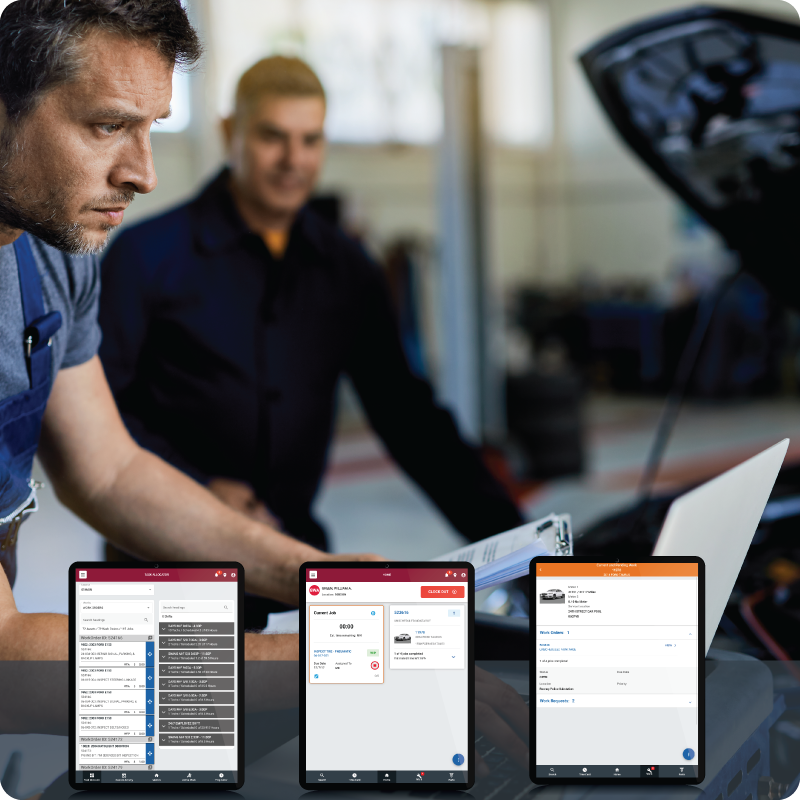
Give your fleet technicians a modern solution to incentivize success by simplifying their work. Our fleet functionality provides all the required tools to create the ideal fleet maintenance workflow from their preferred device. In the system, technicians can manage assigned work, record labor, manage timecards, request parts, and more.
Ready to See More?
Schedule a demo to learn how fleet maintenance software can simplify and improve operations.

Take control of your fuel data
Fuel is vital to your fleet operations, so why do you manage it in a separate system? Bring together fleet and fuel data to improve overall operations.

Make smart, data-backed decisions
Your fleet now generates more data than ever before, so take advantage of modern data analysis tools to make strategic decisions.
Webinar
EAM For Fleets: How to Add Functionality while Lowering Costs
Could your department make use of robust fleet and enterprise asset management software? With AssetWorks Enterprise Asset Management (EAM) software, you can rest assured that your department and community are ready for the future.
Want to learn more about fleet software?
Additional Resources
Learn more about FleetFocus
Our fleet management software is the premier solution for fleets of any size. Watch the video to learn more!
Frequently Asked Questions (FAQs)
Government fleet management software is purpose-built for the operational, regulatory, and reporting requirements of public sector organizations — including municipal governments, county agencies, state departments, public utilities, and federal entities. While commercial fleet software focuses primarily on cost-per-mile and revenue optimization, government fleet software is designed around a different set of priorities: public accountability, budget cycle planning, interdepartmental chargebacks, compliance with government procurement standards, and integration with broader asset management systems that also track roads, facilities, parks, and public infrastructure.
AssetWorks fleet management software for government serves these needs specifically. Because it shares a platform with AssetWorks EAM, government fleet data doesn’t live in a silo — it’s connected to the same system your public works, facilities, and parks departments use. That means a single source of truth for all government assets, not a separate fleet system that can’t talk to anything else your agency manages.
For government agencies, the most valuable fleet management software isn’t a standalone product — it’s one that integrates fully with your broader asset management platform. AssetWorks fleet management is built into the same EAM system your agency uses to manage roads, facilities, parks, and other public infrastructure.
This integration means that fleet assets — vehicles, equipment, trailers — are managed with the same data standards, work order workflows, inventory management processes, and reporting tools as every other asset class in your portfolio. When a fleet vehicle is assigned to a public works project, the costs flow through the same system as the road or utility work being performed. When capital planning decisions are made, fleet replacement data sits alongside infrastructure replacement data — giving leadership a complete picture of capital needs across all departments.
For agencies that already use AssetWorks EAM, adding fleet management is an expansion of your existing platform, not a new system to implement and maintain separately.
Budget justification is one of the most consistent challenges government fleet managers face. Requests for vehicle replacements, shop upgrades, or new technology often compete with higher-visibility priorities — and without data to back them up, fleet managers frequently lose those conversations.
Fleet management software addresses this directly by turning operational data into budget-ready documentation. Lifecycle cost analysis automatically calculates the true cost of each vehicle — combining acquisition cost, maintenance history, fuel consumption, downtime, and depreciation — so fleet managers can identify which vehicles have passed their optimal replacement point and make the case for replacement with numbers rather than judgment calls.
Capital planning reports translate that analysis into year-by-year replacement forecasts that integrate with your agency’s budget cycle. When you can show a county administrator that deferring three vehicle replacements will cost more in maintenance and downtime over the next two years than the replacement cost itself, the conversation changes. The data becomes the argument.
AssetWorks also supports performance reporting that fleet managers can present to oversight bodies, audit committees, and elected officials — showing PM compliance rates, fleet availability, cost-per-mile trends, and maintenance efficiency over time. These aren’t just internal metrics. They’re the documentation that demonstrates responsible stewardship of public assets.
Yes — and for government agencies running a fleet-as-a-service model, internal chargeback is often one of the most important capabilities to get right.
Many government fleets operate as internal service funds, recovering costs from the departments they serve. This requires tracking which department used which vehicle, for how long, at what cost, and generating accurate billing that can be tied back to specific budget codes and cost centers.
AssetWorks fleet management software supports full chargeback functionality — capturing labor, parts, fuel, and usage data at the job and asset level and associating it with the correct departmental cost codes. Billing reports can be generated at the end of any period and exported in formats that integrate with your financial system or ERP.
This capability also creates accountability within user departments. When departments receive itemized bills for fleet usage, they tend to use vehicles more efficiently, report maintenance needs more promptly, and take better care of assigned assets — all of which improves fleet performance and reduces costs agency-wide.
Preventive maintenance compliance is a persistent challenge for government fleets, where vehicles are shared across departments, drivers change frequently, and shop capacity is often constrained. When PM intervals are tracked manually or in disconnected systems, vehicles inevitably slip past their service windows — creating safety risks, accelerating wear, and compliance gaps that show up in audits.
AssetWorks automates the entire PM workflow. Maintenance intervals are configured based on mileage, engine hours, or calendar triggers. When a vehicle approaches its service window, automated notifications go to the assigned driver, the department supervisor, and the fleet shop — giving everyone advance notice to schedule the work before it’s overdue. The system tracks completion in real time and escalates overdue items so nothing falls through the cracks.
The results are measurable. Scott County, Minnesota — a government fleet customer — increased their PM compliance rate from 15–20% to 89.9% in their Sheriff’s Department after implementing automated notifications. The process didn’t change dramatically; the difference was that the system was doing the coordination instead of relying on manual follow-up.
Complete maintenance history is maintained for every asset, creating an auditable record of all scheduled and unscheduled work. This documentation is critical for government fleets facing safety inspections, audit requests, or liability inquiries.
Yes. Government fleets face unique pressures around electric vehicle adoption — state and local EV mandates, grant funding requirements tied to fleet electrification, and the operational challenge of transitioning mixed fleets that include everything from sedans to heavy equipment.
AssetWorks FuelFocusEV provides government fleet managers with full EV charge management integrated directly into the fleet management system. Charging sessions are captured automatically and associated with the correct vehicle and department — treating electricity as a managed fuel source the same way the system manages gasoline, diesel, propane, and CNG. This gives fleet managers a true apples-to-apples cost comparison between ICE and EV vehicles across their entire fleet.
The system supports Level 2 and DC Fast charging, load balancing across charging stations, and take-home charging programs. For government agencies applying for EV grants or reporting fleet emissions data, the system provides the documentation and reporting needed to support those compliance requirements.
Because EV charge management is integrated with the broader fleet and EAM platform, government agencies don’t need a separate system to manage their electric vehicles — the transition happens within the platform they already use.
Government fleet shops often manage work orders across a wide range of vehicle types — light-duty police and administrative vehicles, heavy trucks, specialized equipment, trailers, and yellow iron — with technicians serving multiple departments under a single fleet operation. Without a centralized work order system, coordination breaks down: jobs get lost, labor isn’t tracked accurately, parts aren’t available when needed, and the data needed to report shop performance to leadership doesn’t exist.
AssetWorks work order management gives government fleet shops a complete digital workflow. Work orders are created automatically from PM triggers or manually from service requests. They’re assigned to technicians based on skill and availability, tracked through each stage of completion, and closed with a full record of labor hours, parts used, and costs incurred. Supervisors have a real-time view of everything open in the shop — what’s scheduled, what’s in progress, what’s overdue.
Integration with parts and inventory management means technicians know whether parts are in stock before they start a job, and inventory is automatically decremented as parts are used. Purchase orders for replenishment are generated without manual intervention.
For government agencies that charge maintenance costs back to user departments, every work order produces the billing documentation needed to support the chargeback process — with costs automatically coded to the correct department, project, or budget line.
As an Esri partner, AssetWorks provides bidirectional GIS integration that connects fleet asset data with your agency’s ArcGIS environment in near real time. For government fleets, this means vehicles and equipment can be mapped alongside the infrastructure they service — roads, utilities, parks, facilities — giving fleet managers and field supervisors a spatial view of where assets are deployed and what work is being done where.
Field crews can access work orders by location, view asset details from the map, and update records from mobile devices in the field. Supervisors can see which vehicles are assigned to which geographic areas and identify coverage gaps or resource imbalances.
For public works departments where fleet vehicles are directly tied to infrastructure maintenance — road crews, utility maintenance, parks maintenance — the GIS integration eliminates the disconnect between the fleet system and the asset system. A road maintenance work order, the vehicle performing the work, the crew hours, and the asset being maintained are all connected in one record.
This level of integration is unique to AssetWorks among fleet and EAM vendors — it’s a direct result of the platform being purpose-built for public sector organizations that manage both fleet and infrastructure assets together.